

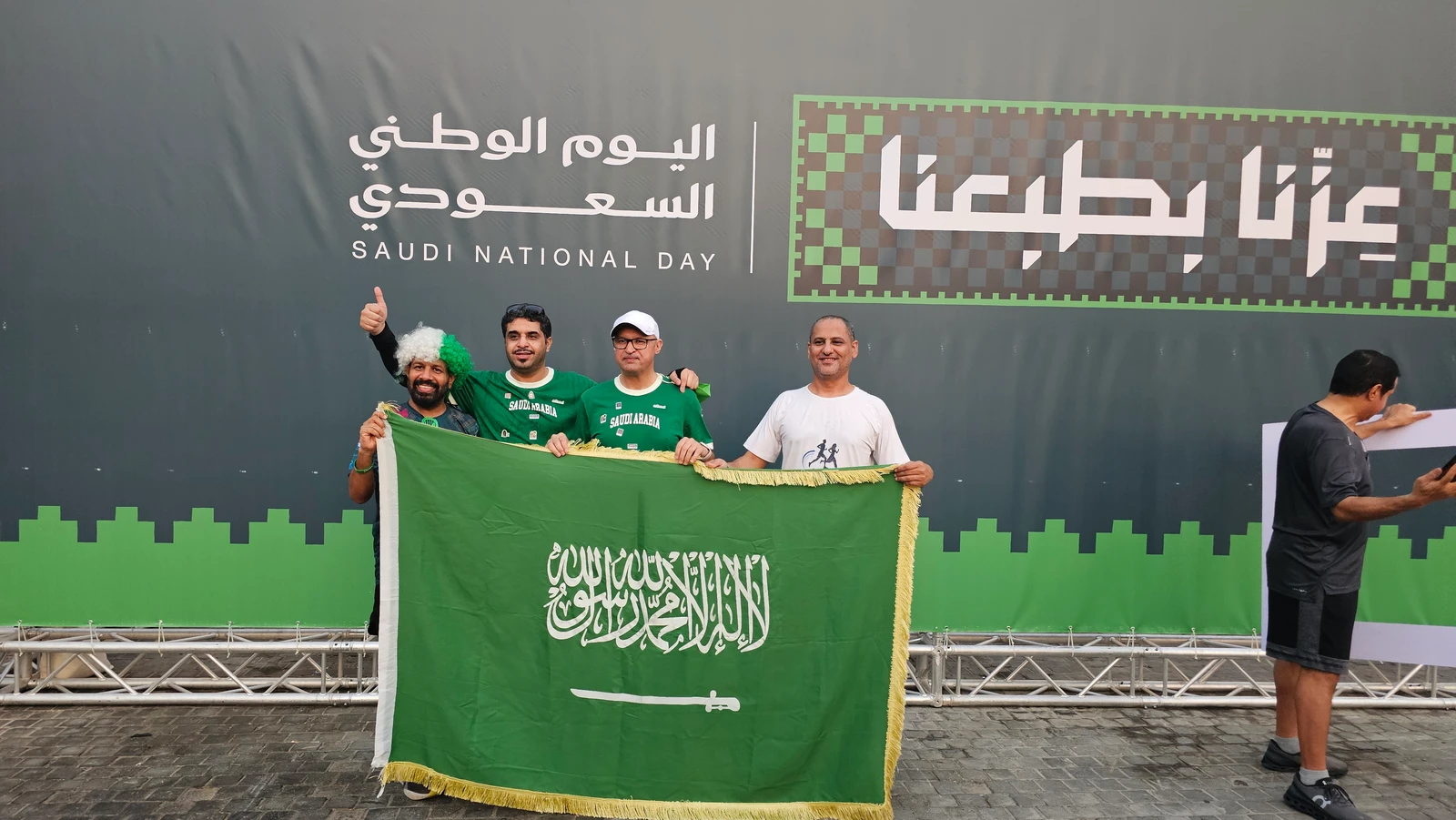
Across the Kingdom, Saudi National Day brings millions of citizens and residents together in a celebration that blends history, culture, and community spirit. From streets illuminated in green and flags waving from homes and vehicles to family gatherings filled with traditional food, music, and storytelling, the occasion reflects a deep connection to Saudi heritage and identity.
In Historic Jeddah, thousands of Saudis and expatriates from different nationalities joined the Saudi National Day Run, transforming the event into a celebration of fitness, unity, and belonging. Families, friends, and communities gathered to mark the occasion while embracing the shared experience of celebrating the Kingdom.
For many Saudis, National Day is more than a public holiday. It is an opportunity to remember the country’s journey, celebrate its achievements, and pass cultural traditions from one generation to the next.
Streets Filled With Pride and Celebration
In Jeddah, King Abdulaziz Road becomes a major gathering point every National Day evening. What is normally a busy road turns into a festive scene filled with decorated cars, national songs, fireworks, and air displays.
For marine engineer Mohannad Garoud, 28, the famous National Day traffic is part of the celebration itself.
“People leave their homes to enjoy the celebrations and see how others have decorated their cars. Everyone celebrates in their own way,” he said.
Garoud spends the evening with friends driving along the road, surrounded by Saudi flags and patriotic songs. His National Day playlist includes classics such as Talal Maddah’s “Watani Al-Habib: Wa Hal Uhibbu Siwah” alongside popular celebration songs that capture the festive atmosphere.
Regional Traditions Keep Heritage Alive
In Jazan, National Day celebrations combine national pride with the region’s distinctive cultural traditions.
Nahla Zamim, a 36-year-old mother of four, explained that the celebration begins with family gatherings before moving into public festivities, where streets and waterfronts are decorated in green.
Traditional clothing plays an important role in the celebrations. Men wear the thobe and bisht, while women showcase embroidered regional garments decorated with Jazan jasmine.
“Our heritage has a strong and very special presence,” Zamim said, noting that folk performances such as the Jazan ardah, samrah, and rabsh are essential parts of the celebrations.
Food is also central to the occasion. Families gather around traditional dishes, including meat prepared in a maghsh stone pot and served with mifa bread, connecting culinary heritage with modern celebrations.
Music adds another layer of meaning, with songs by Jazan-born artist Mohammed Abdu creating a familiar soundtrack for many families during the holiday.
Teaching the Next Generation
In Riyadh, National Day offers families an opportunity to introduce children to Saudi culture through meaningful experiences.
Haneen Shaheen, who works in children’s literature development and publishing, believes that children learn best when knowledge is connected to emotions and real-life experiences.
As a mother of two young children, she uses National Day as a chance to help them understand Saudi culture beyond memorizing historical facts.
“I want my son to learn more about his country on National Day, rather than simply memorize specific historical facts,” she said.
Shaheen introduces her children to traditions through food, music, storytelling, and cultural activities. Family visits to Najd Village, where they experience traditional dining and regional cuisine, are part of her approach to making heritage meaningful.
She also uses children’s books, such as “Alif Ba’ Al-Saudia,” to introduce national symbols, customs, and traditions in an engaging way.
Family Gatherings and Memories
For many families in Riyadh, National Day is centered around togetherness.
Recent graduate Fay Al-Otaibi described the holiday as a time for families to gather, wear green, share traditional meals, and reflect on their connection to the Kingdom.
“Celebrating National Day as a family gives the occasion a deeper meaning,” she said, emphasizing the importance of helping younger generations understand history, culture, and national identity.
University student Abdullah Al-Othaim also highlighted the importance of family stories during the celebration. He said that older generations often share memories of how life in the Kingdom has changed over time.
“Listening to those stories every year is a reminder of just how far the Kingdom has come,” he said.
Celebrating Through Food and Innovation
In the Eastern Province, National Day celebrations are also inspiring creativity in the kitchen.
Culinary arts student Lama Alidrissy from Khobar is using the occasion to reinterpret traditional Saudi flavors through a modern dessert inspired by Hijazi cuisine.
“For National Day this year, I’ll be celebrating through food,” she said, explaining that her project combines traditional flavors with contemporary techniques as part of her culinary studies.
For Alidrissy, food represents more than hospitality — it is a way to preserve heritage while introducing Saudi traditions to new audiences.
A Celebration Connecting Past, Present, and Future
Saudi National Day continues to bring together communities across the Kingdom through shared traditions, cultural expressions, and family connections.
Whether through music on crowded streets, traditional dances in public squares, stories shared between generations, or dishes prepared with pride, the celebration reflects the many ways Saudis express their connection to their homeland.
The occasion serves as both a remembrance of the past and a celebration of the evolving identity of modern Saudi Arabia.